
EPA PFAS Reporting Rule: Key Requirements & Compliance
or complex compliance issues.
clearance and fund security.
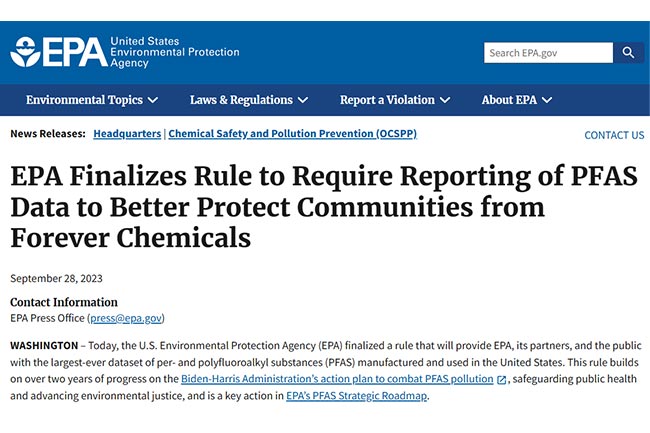
After in - depth discussions,the US Environmental Protection Agency (EPA) officially issued the PFAS Notification Final Rule.This move aims to obtain detailed information on PFAS and its related products in the United States,providing data support for subsequent management strategies and regulation - making.This article will explain in detail the specific requirements of this rule,the PFAS substances involved,and response strategies.
I.Overview of the PFAS Final Rule
Background of the rule: In order to better understand the use and circulation of PFAS in the United States,the EPA decided to collect relevant data and officially implemented this rule on November 13,2023.
Notification requirements: Enterprises that produce or import PFAS or products containing PFAS since 2011 need to submit data on the use,production volume,treatment,exposure,and hazards of PFAS to the EPA within 18 - 24 months after the rule comes into effect.
Exceptional cases: PFAS used as pesticides,food,food additives,drugs,orwill not be within the scope of notification of this rule.
II.Definition of PFAS Substances and Notification Requirements
The EPA has provided an inventory of PFAS subject to notification obligations for enterprises,but it is not comprehensive.The PFAS substances that need to be notified mainly include the following three structures:
1.R-(CF2)-CF(R)R,
R–CF2OCF2–R
3.CF3C(CF3)R’R
Among them,R,R’,and R" in various chemical structures represent different elements or carbons.
III.Risks and Response Suggestions
Violation risks: According to Sections 15 and 16 of the US Toxic Substances Control Act (TSCA),failure to submit information in accordance with the rules will be regarded as illegal.In addition to civil penalties,criminal prosecution may also be imposed.
Coping strategies: It is recommended that all enterprises engaged in trade activities with the US since 2011 immediately check and trace whether their products contain PFAS substances,confirm whether their structures meet the above - mentioned definitions,and ensure timely notification to avoid unnecessary legal risks.
Announcement Text:
Was this helpful? Give us a like!
Contact our experts for compliance audits, precise quotes, and one-stop customs support.
Recent Comments (0) 0
Leave a Reply