
AEB Final Rule: Key Requirements & Impact for Auto
or complex compliance issues.
clearance and fund security.
On May 9,2024,the National Highway Traffic Safety Administration (NHTSA) of the United States issued a final rule notice on establishing federal motor vehicle safety standards for automatic emergency braking systems (AEB) in light vehicles.This rule aims to improve road traffic safety through standardized requirements for vehicle AEB systems.The rule will take effect on July 8,2024,and the compliance requirements for relevant standards will be implemented on September 1,2029.For vehicles produced by small-scale manufacturers or those belonging to the final stage of phased production,the deadline for implementation will be September 1,2030.This article will provide a detailed interpretation of the four requirements of the rule and its impact on relevant enterprises.
I.AEB System Requirements
Vehicles equipped with AEB systems
Under the final rule,all light vehicles must be equipped with AEB systems capable of providing forward collision warnings to drivers via audio-visual alerts when speeds range between 10 km/h and 145 km/h.The warning system components must meet clear requirements to ensure timely and effective communication.This regulation aims to reduce collisions by alerting drivers who fail to detect hazards in time.
1.2 Automatic Braking Function
The AEB system not only provides collision warnings but also performs automatic braking in two specific scenarios.When the vehicle speed is between 10km/h and 145km/h and about to collide with the vehicle ahead,or when the speed is between 10km/h and 73km/h and about to collide with a pedestrian,the AEB system should automatically execute emergency braking.This regulation aims to reduce rear-end collisions and pedestrian accidents,enhancing overall road safety.
II.AEB System Testing Procedures
2.1 Test Procedure Standards
The new safety standards clarify the test procedures for AEB systems,requiring the system to prevent collisions with test vehicles or pedestrian test equipment.The test procedures provide clear definitions of parameters,including driving speed and test scenarios.For example,there are three scenarios for front-vehicle collision tests at 100km/h and four scenarios for pedestrian collision tests.These rigorous standards ensure the AEB system functions effectively under various real-world road conditions.
2.2 False Activation Testing
The rules include two false activation tests: one where the vehicle drives over a steel trough plate,and another where it passes between two parallel parked vehicles.In these scenarios,the AEB system must not engage the brakes beyond a specific allowable threshold.This regulation prevents false activations in non-emergency situations,ensuring normal driving operations are not disrupted.
III.AEB System Fault Detection
3.1 Continuous Monitoring and Notification Function
Vehicles must continuously monitor the AEB system for faults,including performance degradation due to sensor obstructions.In case of system failure,drivers must be notified that the AEB system cannot meet the minimum performance requirements.This ensures drivers are promptly informed and can take appropriate measures to avoid safety risks caused by system malfunctions.
3.2 Maintenance and Servicing
Relevant companies must develop detailed maintenance and servicing plans to ensure the AEB system operates normally.Regular inspections and maintenance of key components such as sensors and control units are required to eliminate potential faults,guaranteeing the systems reliability and stability throughout the vehicles lifespan.
IV.Impact on Exporting Companies and Response Measures
4.1 Tracking and Research on Technical Regulations
Customs reminds export-related companies to strengthen their tracking and research on foreign technical regulations and standards,staying updated on the latest requirements.This not only helps companies respond quickly to regulatory changes but also gives them a competitive edge in the market.In particular,companies should promptly follow up on new standards regarding front-vehicle and pedestrian collision test scenarios and update their testing plans to ensure compliance with the latest safety standards.
4.2 Proactive Measures
Export companies need to take proactive measures to enhance product safety.On one hand,they can improve AEB system performance through technical upgrades and refinements.On the other hand,they can collaborate with international professional testing agencies to ensure products pass strict certification tests before export,meeting the safety standards of importing countries.
NHTSAs new regulations undoubtedly play a significant role in improving road safety.Relevant companies must promptly understand and comply with these standards to ensure product compliance and market competitiveness.We hope this article provides valuable insights to help companies achieve greater success in a competitive market.
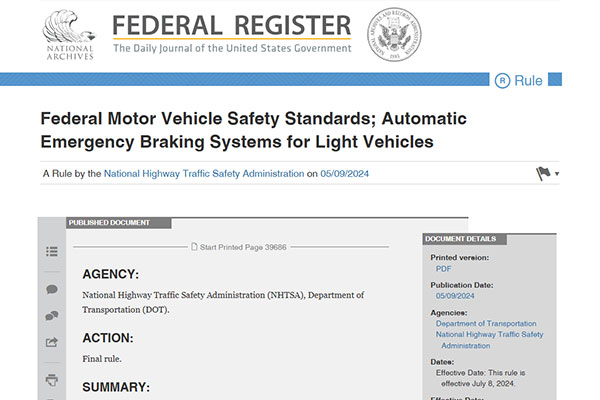
Original Announcement:
Was this helpful? Give us a like!
Contact our experts for compliance audits, precise quotes, and one-stop customs support.
Recent Comments (0) 0
Leave a Reply