
Cross-Border E-commerce Tax Strategies & Deemed Collection Risks
or complex compliance issues.
clearance and fund security.
During the business operation,complex tax issues are faced.Based on the premise that an enterprise can provide valid input vouchers (invoices),the tax authority can quickly determine the enterprises income (net profit),and then the enterprise can pay corporate income tax according to the net profit at the income tax rate.However,many cross - border e - commerce enterprises do not have input invoices in actual operations.
When an enterprise receives overseas payments into the domestic corporate public account and has no input invoices to offset costs,all revenues become net profit,that is,all revenues need to pay corporate income tax.For e - commerce enterprises with a profit margin of only 5% - 20%,this may mean no profit or even losses.
To solve this problem,the state issuedAnnouncement [2019] No.36 of the State Taxation Administrationin 2019.For export e - commerce enterprises without input invoices,the policy of approved collection can be applied in the comprehensive pilot zones.Approved collection means that for the approved enterprises,the income part is calculated according to a fixed ratio based on the operating income,and then the enterprise pays income tax according to the income part at its own income tax rate.However,this policy only applies to self - employed households with an annual income of no more than 5 million yuan.
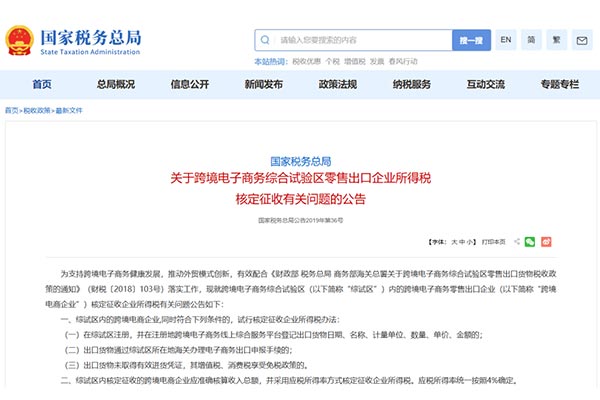
This policy seems attractive at first glance and can help e - commerce achieve compliance,compliant tax payment,and transparent capital flows.However,under the framework of "controlling taxes through invoices," if the deemed profit rate taxation policy were widely applied to the export e-commerce industry,it might lead to a large number of e-commerce businesses no longer seeking invoices from suppliers,which could be unacceptable for the tax authorities.
Therefore,although some places have introduced the approved collection policy to attract e - commerce enterprises to settle in,e - commerce enterprises need to carefully consider whether their business models truly meet the requirements of the approved collection policy when making a choice,otherwise they may face the risk of future liquidation.
Of course,there are also some finance and tax companies that build the overall tax planning framework for larger cross - border e - commerce enterprises.These companies usually integrate multiple elements such as approved collection,export tax rebate and exemption,and tax preferential policies in the comprehensive pilot zones,so that the overall tax burden rate of e - commerce enterprises is controlled between 5% - 15%,thus minimizing the tax burden to the greatest extent within the framework of laws and regulations.
In general,when choosing tax strategies,cross - border e - commerce enterprises need to comprehensively consider the advantages and disadvantages of various policies and make choices based on their actual situations.At the same time,thanks to the services provided by professional finance and tax companies,enterprises can carry out more refined tax planning,so as to maximize their benefits under the premise of compliance.
Was this helpful? Give us a like!
Contact our experts for compliance audits, precise quotes, and one-stop customs support.
Recent Comments (0) 0
Leave a Reply