Home»Food & Beverages» Complete Guide to Chinese Labels on Imported Prepackaged Foods: Regulations, Required Elements & Non-Compliance Handling
When you're at the supermarket or shopping online, have you ever been curious about the Chinese labels on those imported food packages? This small "ID card" is not only a legal requirement but also a helpful window for understanding food safety and nutrition. Especially for popular categories like health supplements andCosmetics, the details on the label directly affect the shopping experience. Today, let's talk about the Chinese labels on imported prepackaged foods, from definition to handling methods, to make your cross-border shopping smarter and more reassuring.
An Introduction to Prepackaged Foods and Labels
Prepackaged foods are those that are pre-quantified and packaged or made in containers, such as a bottle of milk or a bag of chocolate cookies. A food label is an attached tag, hangtag, text, graphic, or symbol on the packaging, like a "manual" for the food, recording key information such as ingredients and shelf life. In short, it helps you buy with understanding and eat with peace of mind.
Why must imported prepackaged foods have Chinese labels?
According to food safety regulations, imported prepackaged foods must have a Chinese label; if a manual is required, it must also be in Chinese. The label and manual must comply with laws, regulations, and national standards, and must also indicate the country of origin and the name, address, and contact information of the domestic agent. Goods without a Chinese label or that do not comply with the regulations cannot be imported. This rule is to protect consumer rights and make it easy for everyone to read product information.
Content elements of a compliant Chinese label
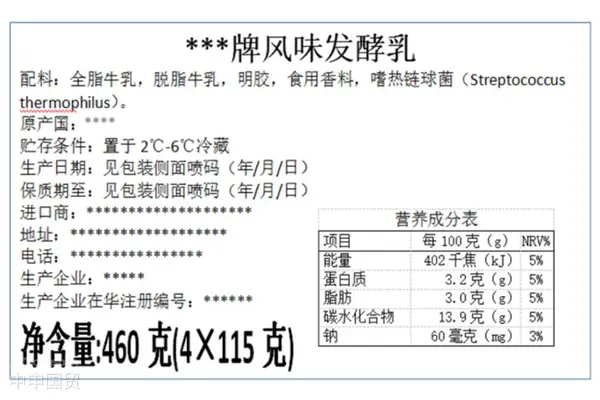
A standard Chinese label must include this core information:
Name, specifications, net content, production date.
List of ingredients or raw materials.
Name, address, and contact information of the importer, agent, or distributor (producer information is optional).
Shelf life.
Storage conditions.
The national standard common name for any food additives used.
Name of the country or region of origin (e.g., Hong Kong, Macau, Taiwan are marked as the place of origin).
Prepackaged foods for direct consumption must also have a nutrition label according to national standards (except for exempted products).
Other matters required by laws, regulations, or standards.
Additional elements are also very useful:
Batch number: Marked by the enterprise for easy tracking.
Directions for use: Including suggestions for opening, using, or cooking.
Allergenic substances: Potentially allergenic ingredients are easily identified in the ingredient list or noted in a nearby location.
Irradiated food: Labeled as "irradiated food"; irradiated ingredients are noted in the list.
This content makes the label more comprehensive and helps you avoid potential risks.
Special provisions: additional requirements for different foods
In addition to the general elements, some foods have specific regulations:
Fresh and frozen meat: Both inner and outer packaging must be labeled in Chinese and English, or Chinese + the language of the exporting country, indicating the country of origin, product name, producer registration number, and production batch number; the outer packaging's Chinese label must state specifications, origin (specific to state/province/city), destination, production date, shelf life, storage temperature, and include an official inspection and quarantine mark.
Seafood: Similar to meat, must state the trade name, scientific name, specifications, production date, batch number, shelf life, storage conditions, production method (wild-caught or farmed), production region, name, registration number, and address (specific to state/province/city) of the production and processing enterprise, with the destination being the People's Republic of China.
Health foods, special dietary foods: The Chinese label must be printed on the smallest sales package and cannot be affixed.
Registration of overseas production enterprises: For foods exported to China produced on or after January 1, 2022, the inner and outer packaging must be marked with the registration number in China or the registration number approved by the exporting country.
These details ensure food safety and traceability.
What if the label is non-compliant?
Every year, imported foods are disposed of due to label issues. Reasons for non-compliance include the absence of a Chinese label, non-standard format, or discrepancies between testing and labeling.
Handling methods: For non-compliance in safety, health, and environmental aspects, the goods are returned or destroyed; for others, technical treatment (such as affixing a label) is possible. If they still do not comply after treatment, they must also be returned or destroyed.
Helpful Tips
The prepackaged food labeling requirements apply to imports through general trade channels. For items entering for exhibition, as samples, for duty-free operations (excluding offshore duty-free), for personal use by embassies and consulates, carried by travelers, sent by mail, express delivery, orCross-border E-commerceforms, affixing a Chinese label is not mandatory, and they are handled according to relevant regulations.
Conclusion
Although the Chinese label on imported food is small, it is a very helpful shopping assistant. Understanding these regulations will make your cross-border purchases more secure and smarter. International trade is rich and varied; paying more attention to details allows you to enjoy good things from around the world. I hope this sharing makes your shopping cart fuller and your life better!










 簡體中文
簡體中文  English
  Русский
  日本語
日本語  Espa?ol de México
  ???
???