Saudi Local Content Demystified: Requirements, Ratios, and Bidding Advantages
Category: Trade GuidesDate: November 13, 2025 08:02
Home»Trade Guides» Saudi Local Content Demystified: Requirements, Ratios, and Bidding Advantages
Over the years, while helping companies export to Saudi Arabia, I’ve been repeatedly asked about “l(fā)ocal content.” To be honest, the Saudi market is full of opportunities, but the rules are pretty particular—especially the localization requirements. One careless move can torpedo a bid. People keep fretting: what percentage of local content turns a product into “l(fā)ocal goods”? Once you hit the threshold, what edge does it actually give you in tenders? Today let’s strip the system bare, sort out the thinking for you, and keep you from stepping on landmines.
What exactly is Saudi Arabia’s “l(fā)ocal content”? It’s far more than just the percentage of local products.
Don’t jump straight to the ratio—let’s start from the top. Saudi Arabia’s “Local Content” regime is really the total amount a contractor spends on Saudi-made factors of production for a project: goods, services, assets, technology, labor, you name it. In plain terms, it measures how much “Saudi flavor” your project has. The system is run by the Local Content & Government Procurement Authority (LCGPA); companies hand over their documentation to LCGPA or an authorized third-party auditor, and if everything checks out they receive a “Local Content Certificate” that states a score. That score is usually a percentage, based on how much you invest in the Kingdom, how many locals you hire, and your procurement strategy.
It mainly looks at several dimensions:
labor force: Total compensation for employees directly involved in the project, especially Saudis.
Capacity building: Training for Saudis, developing local suppliers, and spending on domestic R&D.
Depreciation: The total amount of depreciation for projects executed with Saudi local assets.
Procurement of Goods and Services: Expenditures on goods and services in Saudi Arabia required for the project. However, this is not counted in full; it must be multiplied by their “l(fā)ocalization score.” For example, if you procure?photovoltaic?For the component, the localization cost is calculated as 22% of the purchase price.
What percentage qualifies as a “l(fā)ocal product”? In fact, there is no universal threshold; every project is different, so you have to check the tender documents. Generally speaking, if the localization score of your product or service is high, it can be recognized as “l(fā)ocal.” How is the score calculated? There are two ways:
Predefined score: LCGPA periodically publishes a list that assigns fixed scores to various products, materials, and services. For example, items “Made in Saudi Arabia” receive different scores—financial services can get 75%, whereas PV modules only 22%.
Third-party audit:If you believe your product is more localized, you can have a certifying body audit it—your score might end up higher than the predefined one. For instance, a PV supplier that proves its local-content ratio beats the average can pick up a few extra points.
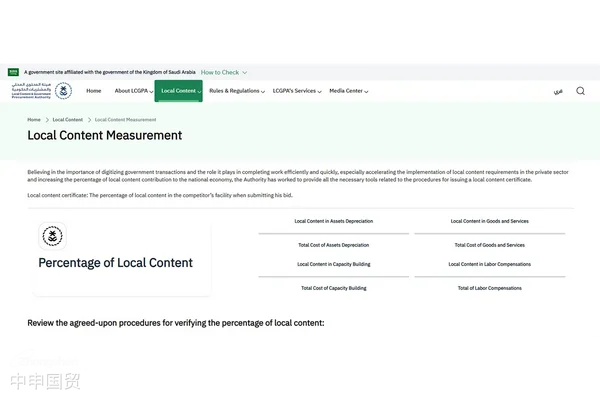
Want to dive deeper into computing? The LCGPA official site has templates and guides—super practical. [LCGPA official website:https://lcgpa.gov.sa/p/en_US/Measure_Local_Content] This section walks you through calculating the Local Content score step by step.
In short, local content is not a rigid percentage but a comprehensive evaluation. Companies must invest more locally, hire Saudis, and use domestic supply chains to see their scores climb steadily.
How much of an edge can localization give you when bidding in Saudi Arabia? It’s packed with advantages.
When it comes to bidding, localization is a secret weapon! The Saudi government is increasingly pushing a “l(fā)ocal-first” policy, showering local products with all kinds of buffs in tenders. Here are the key highlights:
Price markup: Local products enjoy a 10 % price advantage. What does that mean? Even if your bid is 10 % higher than the foreign quote, it’s still treated as a tie in evaluation—or even better. That instantly boosts your competitiveness and frees you from fearing a price war.
Mandatory List: LCGPA will issue a list of locally produced items and update it regularly. Products on the list will be given priority in procurement.
Minimum requirements:Tender documents usually set a floor—say, a minimum local-content ratio that must be hit during the contract period. Fall short? You could be out on the spot.
Scoring weight: During the financial evaluation phase, localized content carries a certain weight. Companies with higher scores will have a higher overall bid score.
Tender bias: Saudi bid evaluation focuses heavily on price; the lowest bid usually wins. Under equal terms, local firms come first, followed by Saudi-majority joint ventures. Foreign investors want a slice of the pie? Double down on localization.
These advantages don’t come free—you’ll need certificates to prove you qualify. For more details, take a look at the LCGPA homepage. [LCGPA website:https://lcgpa.gov.sa/p/en_US/Home]
Conclusion: Localization is a long-term investment—don’t focus only on the short term.
At the end of the day, Saudi Arabia’s local-content program isn’t a hurdle—it’s an opportunity. There’s no fixed minimum, but the higher your score, the better your chances of winning tenders. Start by targeting the pre-defined point categories; once you’re established, bring in auditors to push the score even higher. Don’t see it as a headache—early moves like building a local supply chain, hiring Saudis, and investing in training turn into real competitive edges. Have you worked on any Saudi projects? Share your story—let’s swap notes! If you’re unsure, hit the official website right now and get moving.






 簡體中文
簡體中文  English
  Русский
  日本語
日本語  Espa?ol de México
  ???
???