
Mastering Ocean Freight Costs: A Comprehensive Guide
or complex compliance issues.
clearance and fund security.
In theI.Various Freight Miscellaneous Fees that Cargo Owners Need to Know
II.CIC Fees (Container Imbalance Charge)
1.ORC (Origin Receiving Charge):
The origin terminal handling charge is collected at the port of shipment and covers expenses such as the handling and storage of goods at the port of origin.2.DDC (Destination Delivery Charge):
The destination delivery charge is collected at the port of destination and is used to cover the unloading and handling expenses of goods at the port of destination.3.THC (Terminal Handling Charge):
The terminal handling charge,that is,the container lifting charge,involves the loading and unloading expenses of goods at the terminal.4.BAF (Bunker Adjustment Factor)/FAF (Fuel Adjustment Factor):
The bunker adjustment factor/fuel adjustment factor is a fee charged due to fluctuations in fuel prices.5.CAF (Currency Adjustment Factor):
The currency adjustment factor reflects the impact of currency exchange rate changes on freight.6.DOC (Document Fee):
The document fee is the cost of processing various transportation and customs documents.7.PSS (Peak Season Surcharge):
The peak season surcharge is an additional fee charged during peak seasons to cope with tight shipping capacity.8.AMS (America Manifest System):
The America Manifest System is a fee for reporting to the US Customs.CIC fees,also known as container imbalance charges or equipment management fees,are mainly incurred due to seasonal changes in cargo transportation,trade volume imbalances,or differences in the types and nature of goods.This is a fee charged by shipping companies to balance the supply and demand of containers in different regions.
III.CFS Fees (Container Freight Station)
CFS fees are related to LCL (less - than - container - load) goods and mainly occur at the port of loading and the port of destination,involving operations such as the receipt,stowage,and unpacking of LCL goods.Under the FOB trading terms,the CFS fees at the port of loading are usually borne by the exporter; while under the CIF terms,these fees are already included in the ocean freight rate.EBS fees,that is,emergency bunker surcharges,are temporary fees charged when the international crude oil price rises significantly beyond the shipowners affordability.It is a supplement to the BAF fees and reflects the sudden increase in fuel costs.
IV.EBS Fees (Emergency Bunker Surcharge)
Local charges mainly include booking fees,customs declaration fees,THC,document fees,handling fees,etc.The names and amounts of these fees may vary in different countries and ports.Understanding these fees is very important for evaluating the overall transportation cost.
V.LOCAL CHARGE (Local Charges)
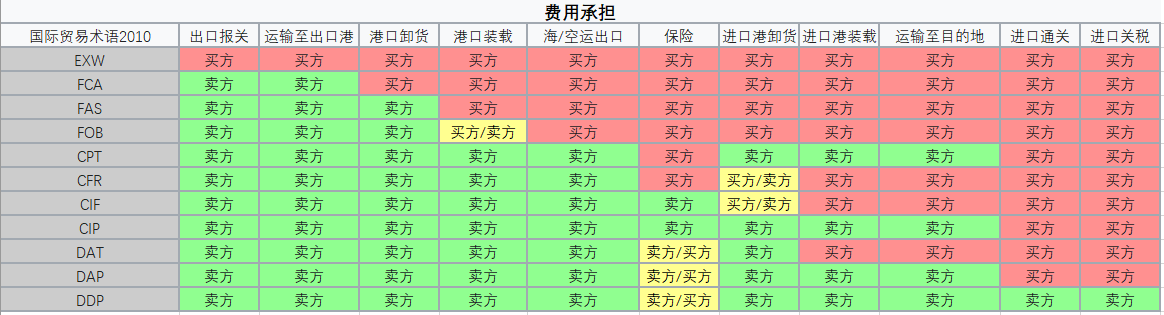
1.EXW (Ex - Works):
VI.Expense Assumption under Trade Terms
The buyer is responsible for all expenses starting from picking up the goods at the factory.
Ocean shipping fees include not only basic transportation fees but also various miscellaneous fees,which may be charged by shipowners,terminals,or freight forwarders.Understanding these fees is crucial for avoiding additional costs:
2.FOB (Free on Board): The seller bears the expenses until the goods pass the ships rail,and the expenses thereafter are borne by the buyer.
3.CIF (Cost,Insurance and Freight): The seller is responsible for transporting the goods to the port of destination and bears the freight and insurance costs.
CFR (Cost and Freight): The seller is responsible for the freight to the port of destination,but the buyer is responsible for the insurance.
Understanding these shipping - related costs and their assumption methods helps cargo owners and exporters effectively control costs and avoid additional expenses,thus maintaining a competitive edge in international trade.Ensuring that both parties have a clear understanding and agreement on the assumption of various costs before signing the contract is the key to avoiding disputes and additional costs later.Comprehensive Analysis of Shipping - Related Costs and Cost Assumption under Trade Terms | Shanghai Import/Export Agent
September 12th,2024,09: 27
Was this helpful? Give us a like!
Contact our experts for compliance audits, precise quotes, and one-stop customs support.
Recent Comments (0) 0
Leave a Reply