
If the CAS number doesn't match, just hand it over to the anti-smuggling department? A practical guide to classifying and complying with dangerous goods imports to avoid pitfalls
or complex compliance issues.
clearance and fund security.
Last Wednesday,an old client of mine in Hangzhou,who specializes in fine chemicals,urgently contacted me,saying that a batch of "surface treatment agents" they imported from Japan had been detained by the customs at Shanghai Port.
The situation is quite typical: The batch of goods was shipped under the FOB terms,and the MSDS (Material Safety Data Sheet) provided by the supplier indicated in Item 14 of the transport information that it was a "non-hazardous product (Not Regulated)".Therefore,the customs declarant classified it as an ordinary chemical product under HS code 3402 (organic surfactant products).However,during the customs inspection,samples were taken for testing,and it was found that the flash point of the product was 58℃,and the main component contained controlled organic solvents.The customs determined that the goods belonged to Category 3 flammable liquids listed in the "Dangerous Chemicals Catalogue",and the HS code should be classified as 3814 (organic compound solvents).
The result was disastrous: not only did the goods have to be moved from the general cargo yard to the dangerous warehouse (incurring huge storage transfer fees and dangerous warehouse rent),but the company also faced administrative penalties for "suspected evasion of commodity inspection" and "false declaration of tax codes",and was even handed over to the anti-smuggling department for processing.The entire supply chain was shut down for nearly 20 days.
This case reveals the biggest pain point in the import of hazardous chemicals: There is a huge information gap between commercial documents,transportation standards,and customs supervision standards. Many importers assume that when manufacturers say "non-hazardous",they mean "general cargo",but they don’t realize that customs classifications are based on specific criteria.Component and physical-chemical propertiesInstead of the shipper’s transportation suggestions.

First,why is it so easy to fall into traps when classifying hazardous chemicals?
In practice,importers often face a situation of "three parties clashing": the supplier wants to protect the formula secrecy,the logistics company wants to charge normal freight rates,and the customs requires 100% accurate declaration.The following are the core contradictions that lead to classification errors and customs clearance delays:
| Contradictory Dimensions | From the perspective of suppliers/logistics | From the Perspective of China’s Customs Supervision | Our Preventive Measures |
| Ingredient Disclosure | They tend to hide <10% of the key ingredients,labeling them as "Additives" or "Secret". | It is necessary to make a declarative disclosureIt is required to provide the full list of ingredients and their corresponding CAS numbers. | The classification basis is insufficient,triggering sampling and inspection,and the port detention fees have soared |
| Hazard assessment | According to the IATA/IMDG rules (e.g.small packages may be exempted) | According to the Catalogue of Hazardous Chemicals (2015 Edition and Update),Regardless of the size of the packaging,we only consider its nature | Suspected of evading customs inspection and quarantine (CIQ),the goods are facing the risk of being returned or destroyed |
| Product Name Description | Business generic names (such as "cleaning agent" and "curing agent") | Standard chemical name or description of specific use | When classified under the "catch-all tax code" (such as 3824),the tax rate may be relatively high,and the goods are prone to being subject to special supervision and controls |
| Flash point standard | We often overlook the critical value of less than 60℃. | Closed-cup flash point ≤60℃It is usually regarded as a Category 3 flammable liquid. | Exporting general cargo as hazardous chemicals and being fined,or declaring hazardous chemicals as general cargo and facing criminal charges |
II.Classification and declaration of hazardous chemicals for import
To solve the above problem,we can’t wait until the goods arrive at the port to take remedial measures.We must take compliance actions in advance.Before signing the contract (PO).
Phase 1: Categorization and Qualitative Analysis (2-3 weeks before shipment) Output:
The core principle of customs classification is:First,determine the nature (whether it’s pure or not),then identify its components and usage.
- PurityJudgment:
- Singlecomponent(purity≥95%):ThevastmajorityofthemfallintothecategoryofChapter28(Inorganicchemicals)orChapter29(Organicchemicals).
- Exception:Evenifit’sverypure,ifit’smadeintoaspecificshapeorpackagedforretailsale,itmightfalloutsidethescopeofChapters28/29.
- Mixture (formulation): Usually classified under Chapters 30-38.
- PracticalOperationSkills:Ifit’samixedsolvent,itfallsunderthecategoryof3814;ifit’sacleaning/decontaminationfunction,itfallsunderthecategoryof3402;ifit’salubricationfunction,itfallsunderthecategoryof2710or3403.
- Singlecomponent(purity≥95%):ThevastmajorityofthemfallintothecategoryofChapter28(Inorganicchemicals)orChapter29(Organicchemicals).
- Hazard Pre-review (Key Action):
- AfterreceivingtheMSDS,checkitimmediatelyCASnumberIsitincludedintheCatalogueofHazardousChemicals?
- Forcedaction:Regardlessofwhatthesuppliersays,itisrecommendedtohavethe"ImportedHazardousChemicalsClassificationandIdentificationReport"donebyqualifiedinstitutionsinChina(suchastheShanghaiChemicalIndustryResearchInstituteandtheQingdaoCustomsTechnologyCenter).Thisisthe"IDcard"recognizedbythecustoms.
Phase 2: Document preparation and review (1 week before shipment) Output:
Under the CIF or FOB terms,it is necessary to complete the verification of "consistency between the documents and the order" before shipment.The following is a list of documents required for the import of hazardous chemicals:
| Document Type | Key verification points | Responsible Party | Remarks |
| MSDS (Chinese Version) | It must be in accordance withChina National Standard (GB/T 16483) This is the Chinese version.The first item (chemical name),the second item (hazardousness),and the third item (CAS number of the component) must be accurate. | Import/supplier | The customs do not accept MSDS in pure English. |
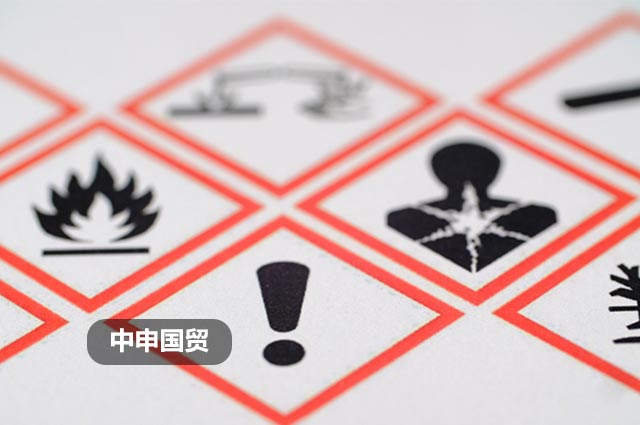
| Chinese Hazard Communication Label (GHS) | It must include signal words (such as "danger"),pictograms,precautionary instructions,and a 24-hour emergency phone number in China.It must be affixed before the goods are shipped abroad! | Supplier (Shipper) | Every single smallest packaging unit needs to be labeled,not just the pallets |
| Classification and Identification Report | Is the conclusion that it is a "dangerous chemical"?Are the UN number and packaging category (Class I/II/III) consistent with the customs declaration form? | Third-party appraisal institutions | The core basis for customs declaration |
| Paint Registration Certificate | If the HS code involves paints under items 3208/3209,the registration must be completed two months in advance. | Importer | Special supervision documents that are easily overlooked |
Stage 3: Declaration and Inspection (before and after arrival at the port) Output:
- SingleWindowDeclaration:
- Inthe"GoodsAttributes"column,truthfullycheck"Bulk/piece-packeddangerouschemicals".
- Inthe"DangerousGoodsInformation"column,accuratelyfillintheUNnumber,thehazardousgoodscode,andthepackagingcategory.
- Note:In2025,thecustomssystemstrengthenedlogicalverification.IftheCASnumberbelongstothehazardouschemicalcatalogbutisnotmarkedashazardous,thesystemwillissueanimmediatewarning.
- Electronic Ledger:
- Importedhazardouschemicalsaresubjecttostatutoryinspection(legalinspection),andpriortocustomsdeclaration,theymustfirstundergoinspectionandobtainanelectronicbaserecord.
- Inthe"GoodsAttributes"column,truthfullycheck"Bulk/piece-packeddangerouschemicals".
- Inthe"DangerousGoodsInformation"column,accuratelyfillintheUNnumber,thehazardousgoodscode,andthepackagingcategory.
- Note:In2025,thecustomssystemstrengthenedlogicalverification.IftheCASnumberbelongstothehazardouschemicalcatalogbutisnotmarkedashazardous,thesystemwillissueanimmediatewarning.
- Importedhazardouschemicalsaresubjecttostatutoryinspection(legalinspection),andpriortocustomsdeclaration,theymustfirstundergoinspectionandobtainanelectronicbaserecord.
III.Experts’ Advice on Avoiding Pitfalls and Risks
As a consultant who has handled the customs clearance of chemical products for many years,I would like to offer three in-depth suggestions here:
1.Misconceptions about "reagents" and "samples"
Many companies think that importing a few 500ml laboratory samples is as simple as sending them via express delivery.Big Mistake! Customs supervision of hazardous chemicalsWithout regard to quantityEven if it’s just 100 grams,as long as it’s a hazardous chemical listed in the Catalogue,it must be declared in accordance with the formal hazardous chemical procedures,affixed with Chinese labels,and subject to commercial inspection.Smuggling hazardous chemicals through express delivery channels is currently a key target of customs crackdowns.
2.Compliance of packaging containers (UN marking)
The customs not only inspect the goods,but also check the packaging.The packaging barrels/boxes of hazardous chemicals must have permanent markings on them.UN Marking(For example u/n 1A1/Y1.2/100.).If it is an ordinary carton or uncertified plastic drum,even if the goods are fine,they will be required to be returned or destroyed due to "unqualified packaging," and rectification is impossible.
3.Traceability requirements of "one enterprise,one product,one code"
In 2025,regulatory trends will become increasingly digitalized.Some ports have begun piloting traceability codes for hazardous chemicals.Importers need to complete registration in the "Integrated Service System for Hazardous Chemical Registration",generate traceability QR codes,and gradually require these codes to be affixed to the packaging of imported products.Please be sure to pay attention to the latest announcements from the customs authorities at the ports of destination.
IV.Immediate Action List
If your goods are about to be shipped or you are currently negotiating a contract,please immediately conduct the following checks:
CAS Number Penetration Check: Without looking at the product name,directly extract all CAS numbers from Item 3 of the MSDS and screen them against the 2015 Edition of the Dangerous Chemicals Catalogue.
Obtain Identification Report: It is mandatory for suppliers to cooperate or send samples for a preliminary "Classification and Identification Report" to be conducted domestically,which will serve as the final basis for classification and declaration.
Pre-review Chinese label: Design a Chinese label PDF that complies with China’s GHS standards,send it to foreign suppliers,and require them to print it (in color,especially the red diamond-shaped frame) and attach it to each minimum sales package.
Confirm the emergency phone number: The 24-hour emergency phone number on the label must be a landline phone number in China with someone answering the call.If not,please contact an agency to purchase this service.
Was this helpful? Give us a like!
Contact our experts for compliance audits, precise quotes, and one-stop customs support.
Recent Comments (0) 0
Leave a Reply