
Glyphosate EU Re-Approval: Understanding Commission's Decision
or complex compliance issues.
clearance and fund security.
The European Commission has recently responded to the re - evaluation of glyphosate.This response involves the carcinogenicity of glyphosate and the issue of newly added related impurities.Glyphosate is a widely used herbicide,and its safety and environmental protection issues have always been the focus of attention of the public,the scientific community,and policymakers.This article will explore in detail the European Commissions decision on the re - evaluation of glyphosate and the regulatory rules behind it.
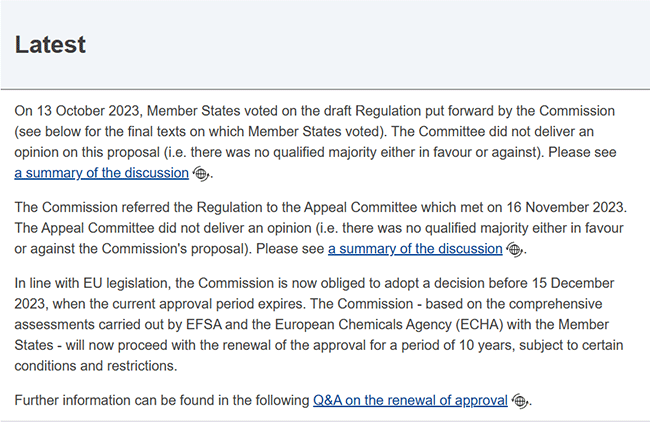
I.Extension of Glyphosate Approval
The European Commission has decided to extend the approval of glyphosate,which is based on the assessment of the impact of glyphosate on human,animal,and environmental health by the European Food Safety Authority (EFSA).The European Commission must make a decision before the expiration of the current approval of the active substance (December 15,2023).Although a majority vote was not reached in the appeal committee to extend the 10 - year validity period of glyphosate,based on the EFSAs assessment,no major concerns that could prevent the extension of glyphosate approval were identified.
II.Basis for the Commissions Decision
The decision of the Commission is based on comprehensive safety assessments carried out by EFSA,the European Chemicals Agency (ECHA),and the Member States.This scientific work takes into account all available information,including mandatory regulatory studies required by EU regulations and a large number of published scientific literatures.The applicant screened over 16,000 published studies,and approximately 780 relevant publications were used for the assessment.
III.Impact on the Authorized Use of Glyphosate - containing Products in Member States
How will the re - evaluation approval decision at the EU level affect the authorized use of glyphosate - containing products in Member States?The EUs regulatory system stipulates a two - step procedure for bringing plant protection products (PPP) to the market.Member States are responsible for the national authorization of PPP containing glyphosate,taking into account the specific conditions set at the EU level and national circumstances.After the approval renewal,all national authorizations must be reviewed and evaluated in accordance with the conditions and restrictions set in the renewal approval.
IV.Reasons for Extending the Validity Period of Glyphosate for 10 Years
Normally,the extended validity period after the re - evaluation of an active substance is 15 years.However,in the case of glyphosate,the Commission has set the extended validity period at 10 years.This is because glyphosate has been verified twice to meet the approval criteria specified in EU pesticide legislation.In addition,it is expected that no significant new scientific information or knowledge leading to different results will emerge in the short term.Therefore,setting a shorter approval period is to balance these considerations.
V.Usage Conditions and Restrictions in the Decision
As part of the proposal for the re - evaluation approval of glyphosate,the Commission has included several new conditions,such as banning its use as a desiccant,setting maximum limits for five impurities in glyphosate,requiring Member States to pay special attention to specific aspects when conducting risk assessments,and setting maximum application rates.
VI.Response to Whether Glyphosate is a Carcinogen
Based on the assessment of all available information,there is currently no evidence to classify glyphosate as a carcinogen.Both ECHA and EFSA confirm that glyphosate should not be classified as a carcinogen,which is a view commonly recognized by most major regulatory agencies globally.
VII.Whether the Current Decision Will Be Re - examined if New Scientific Evidence Emerges
If new evidence emerges indicating that the approval criteria have not been met,the Commission will take immediate action to revise or revoke the approval as scientifically necessary.
Original text of related questions:
Was this helpful? Give us a like!
Contact our experts for compliance audits, precise quotes, and one-stop customs support.
Recent Comments (0) 0
Leave a Reply