
Export Mechanical Parts: HS Code Classification Guide
or complex compliance issues.
clearance and fund security.
How to classify the customs declaration of exported mechanical and electrical commodity parts?This question seems simple,but in fact it involves knowledge in many fields such as international trade,customs regulations,and mechanical and electrical technology.In todays globalization,correctly classifying mechanical and electrical commodity parts is crucial to ensuring the smooth progress of international trade.Below,we will discuss this question in detail from three aspects.
I.What are the parts of mechanical and electrical commodities
First of all,we need to clearly define what constitutes parts of electromechanical goods.In international trade,particularly within the Harmonized System (HS),the concept of "parts" has a specific definition.The Harmonized System is an internationally standardized system for classifying and coding goods,and it provides clear descriptions of parts for electromechanical goods.Generally,any component of a machine or equipment can be considered a "part," but these parts often do not have independent functionality; they need to be assembled into the complete machine to function.When classifying,we must distinguish between parts and complete machines,as the latter possess independent functionality,whereas parts typically do not.
II.Classification principles of parts
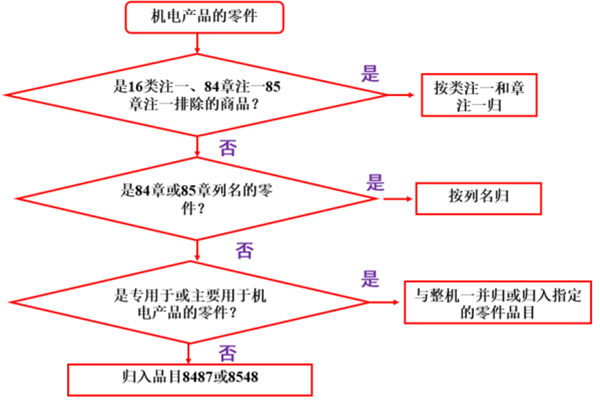
After understanding what are the parts of mechanical and electrical commodities,lets take a look at how to classify them.The classification principles are the basic rules for guiding the customs declaration of exported mechanical and electrical commodity parts.According to the notes of Section XVI of the Harmonized System,we can summarize the classification principles as follows:
Principle of specific listing: If a part has a specific listing in Chapter 84 or Chapter 85,it should be classified according to the listing.
Principle of special purpose: Parts that are specially or mainly used for a certain machine or multiple machines of the same heading should be classified together with the machine or into a specific heading.
Principle of universality: General parts that do not have special purpose are classified into general headings,such as Heading 84.87,85.48 or 90.33.
In actual operation,we also need to consider the provisions of the exclusive clauses,that is,the special provisions in the section notes and chapter notes.These provisions may affect the classification of parts.
III.Analysis of typical cases
To better understand these principles,lets look at some typical cases:
Plastic transmission belt for coating and developing machine: According to the exclusive clause in Note 1 of Section XVI,this kind of commodity should be classified into Chapter 39.
Steel gasoline filter for automobiles: Since this commodity has a specific listing in Chapter 84 (machines and apparatus for filtering or purifying liquids),it should be classified into Heading 8421.
Plastic frame for mobile phones: As a component of mobile phones,according to its shape and special purpose,it should be classified into Heading 8517.7030.
Oil seal ring: Since this is a non - special part that can be used in multiple machines or devices,it should be classified into Heading 8487 (parts of non - electrical machines not specified or included elsewhere).
Through these cases,we can see that correctly classifying mechanical and electrical commodity parts is a job that requires careful consideration and professional knowledge.Only by deeply understanding the specific characteristics and uses of the commodity and combining the provisions of the Harmonized System can an accurate classification decision be made.
Was this helpful? Give us a like!
Contact our experts for compliance audits, precise quotes, and one-stop customs support.
Recent Comments (0) 0
Leave a Reply