
CPT Incoterms Explained: Advantages & Application Guide
or complex compliance issues.
clearance and fund security.
Master CPT Incoterms to optimize your global supply chain.Understand its key advantages,responsibilities,and practical application tips for efficient international trade.Learn more today.
I.The content of CPT
CPT (Carriage Paid To) is one of the Incoterms rules published by the International Chamber of Commerce.It stipulates which responsibilities are borne by the seller and which are borne by the buyer in each link from the export to the import of goods.Under the CPT condition,the seller is responsible for safely delivering the goods to the designated destination and bears all transportation costs from the place of departure to the destination,including but not limited to domestic and international transportation costs,loading and unloading costs,etc.Once the goods are delivered to the carrier,the buyer shall bear further costs and responsibilities.This includes not only transportation costs but also possible taxes,duties,insurance costs,etc.In addition,the seller also needs to purchase basic transportation insurance for the goods and is responsible for providing all necessary transportation and delivery documents.
II.Why Choose the CPT Condition?
The CPT clause has become a very popular trading condition in international trade due to its clear division of responsibilities and cost - sharing mechanism.First of all,since the seller is responsible for all transportation costs,this to a certain extent reduces the burden on the buyer,making it more willing to conduct transactions.Secondly,the seller is responsible for the entire transportation process of the goods from the starting point to the destination,which not only reduces the operational burden on the buyer but also reduces its risks during the transportation process.Finally,as the beneficiary of the transportation contract,the buyer can handle relevant matters more flexibly after the goods arrive at the destination,such as customs clearance,further transportation,etc.
CIP is particularly suitable for multimodal transport.In multimodal transport,goods may reach the destination through multiple modes of transportation (such as railway,air,etc.).The flexibility of CIP lies in that the carrier can be a single transportation company or an operator managing multimodal transport.This flexibility makes CIP a very practical and efficient transportation and delivery method.Compared with other delivery methods,the CIP mode can greatly shorten the overall transaction time.CIP not only has advantages in logistics but also performs well in financial management.After the goods are delivered to the carrier,the seller can immediately collect the payment from the buyer by submitting the corresponding transportation documents (such as ocean bill of lading,railway bill of lading,air waybill or multimodal transport bill of lading,etc.).This mechanism significantly reduces the waiting time,thus helping the seller recover funds faster and optimize capital turnover.
Choosing to use the CPT clause undoubtedly brings convenience to both parties,but this does not mean that they can take it lightly.Both parties should carefully read and understand all the terms and details of CPT in the contract,especially those regarding the sharing of costs,responsibilities,and risks.The seller needs to ensure that all necessary transportation and delivery documents are provided and that these documents fully meet the contract requirements.The buyer needs to provide clear and accurate transportation instructions so that the seller can correctly handle all transportation details.In addition,the buyer also needs to be prepared to handle all necessary customs clearance procedures and further transportation and cost payments after the goods arrive at the destination.The EU Carbon Tariff Transition Period is Approaching: Analysis of Response Strategies and Calculation Logic for Export Enterprises
III.Suggestions on the Correct Application of CPT
Trade Terms | CPT: A Comprehensive Understanding of Its Advantages and Application Suggestions
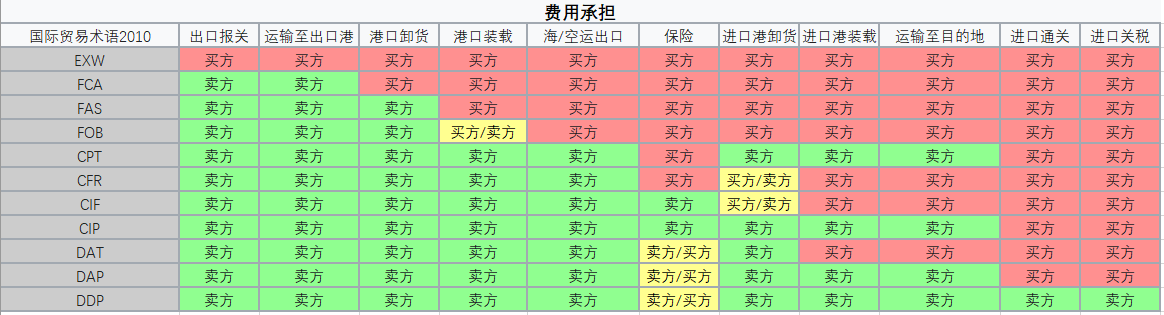
List of Parties Responsible for Costs between Buyers and Sellers under Various Trade Terms
Was this helpful? Give us a like!
Contact our experts for compliance audits, precise quotes, and one-stop customs support.
Recent Comments (0) 0
Leave a Reply