
Import Catalyst Guide: Customs Clearance & HS Codes
or complex compliance issues.
clearance and fund security.
When we talk about catalysts,most people might associate them with terms from high school chemistry textbooks.In fact,catalysts are ubiquitous in our daily lives and modern industry,hailed as the chips of the chemical industry.So,when it comes to importing catalysts,a fundamental chemical material,how should enterprises operate to ensure smooth customs clearance?Below is a detailed analysis of the classification and declaration considerations for importing catalysts.
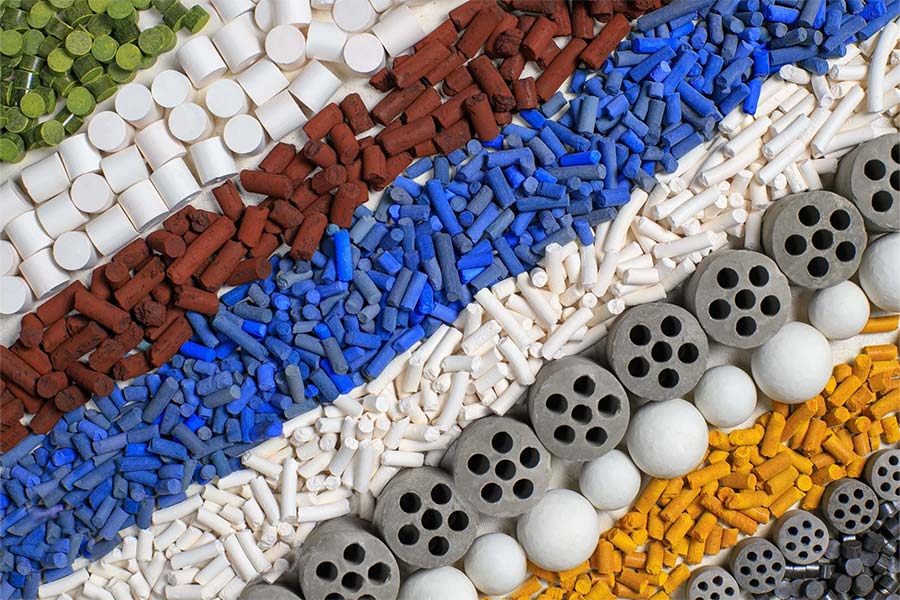
What is a catalyst?
According to the definition by the International Union of Pure and Applied Chemistry (IUPAC),a catalyst is a substance that increases the rate of a chemical reaction without altering the total standard Gibbs free energy of the reaction.Catalysts lower the activation energy of reactants,enabling chemical reactions to proceed at lower temperatures,while their own mass and chemical properties remain unchanged during the process.Hence,they are also referred to as agents.
Classification of catalysts
Catalysts come in numerous varieties and can be classified based on different criteria:
? By state: Liquid catalysts and solid catalysts.
? By phase of the reaction system: Homogeneous catalysts (e.g.acids,bases,soluble transition metal compounds) and heterogeneous catalysts (e.g.solid acid catalysts,metal oxide catalysts).
? By reaction type: Catalysts for polymerization,polycondensation,esterification,hydrogenation,oxidation,reduction,etc.
? By effect magnitude: Main catalysts and co-catalysts.
Applications of catalysts
Catalysts are widely used in petrochemical,biochemical,and environmental protection fields.They play an irreplaceable role in three major application scenarios: petroleum refining,chemical synthesis,and environmental treatment.Therefore,catalysts have vast development prospects and extensive applications across global industries.
Classification of catalysts
According to theAccording to the Explanatory Notes to the Harmonized System (2022) and the Customs Import and Export Tariff of the Peoples Republic of China (2024),catalysts are generally classified under tariff heading 38.15,which covers reaction initiators,reaction accelerators,and catalysts not elsewhere specified.This includes the following two main categories:
Supported catalysts: Composed of one or more active substances (e.g.metals,metal oxides) deposited on a carrier or mixtures based on active substances.Commonly used metals include cobalt,nickel,palladium,platinum,and molybdenum,with carriers typically made of materials like alumina,carbon,or silica gel.
Specific compound catalysts: Mixtures based on certain compounds,varying by chemical reaction properties and proportions,often used in polymer preparation processes,such as free radical catalysts and ionic catalysts.
Important Considerations
The following categories are excluded:
(1) Waste catalysts for extracting base metals or preparing base metal compounds (heading 26.20).
(2) Separate chemically defined compounds (Chapter 28 or 29).
(3) Pure metal or pure metal alloy catalysts (Section XIV or XV).
(4) Prepared rubber accelerators for rubber vulcanization (heading 38.12).
Import declaration considerations
In order to promote trade facilitation and expedite customs clearance,importers of catalysts must declare their goods in strict accordance with the requirements set forth in the "Customs Declaration Catalogue and Interpretation of Import and Export Commodities of the People’s Republic of China (2024)" when importing catalysts.
Standard Declaration Elements
When declaring imported catalysts,enterprises must ensure the accuracy and completeness of the following elements:
? Product Name: Clearly specify the exact name of the catalyst.
? Purpose: For example,promoting the polymerization of certain polymers.
? Composition Content: Accurately declare the types and percentages of all substances contained in the product,especially precious metals such as platinum,rhodium,and palladium,typically expressed as percentages.
Additionally,the following price elements should be included:
? Brand (Chinese or foreign name)
? Model: The specific model or specification of the catalyst.
Special Fees and Calculation of Duty-Paid Value
Royalty Fees: If enterprises pay royalty fees in the form of non-trade foreign exchange that are related to the imported catalyst and constitute a condition for the sale of the goods within the Peoples Republic of China,the corresponding royalty fees must be proportionally calculated and included in the duty-paid value of the imported catalyst.
Customs Declaration Process
When declaring the import of catalysts,enterprises must follow these key steps:
(1) Document preparation: Including the bill of lading,commercial invoice,packing list,certificate of origin,and composition analysis report.
(2) Customs Declaration: Complete the customs declaration form as required and provide all necessary documents and materials.
(3) Tax Payment: Timely pay the calculated customs duties and VAT amounts as determined by customs.
(4) Inspection and Release: Customs conducts necessary inspections and releases the goods upon confirmation of compliance.
Although the process of importing catalysts is complex,understanding the classification and declaration rules and preparing thoroughly for each step can ensure smooth customs clearance.Enterprises must pay attention to details,especially providing complete and accurate information during the declaration process,to avoid unnecessary delays and costs.This not only improves clearance efficiency but also effectively reduces costs,giving enterprises a competitive edge in the market.
Was this helpful? Give us a like!
Contact our experts for compliance audits, precise quotes, and one-stop customs support.
Recent Comments (0) 0
Leave a Reply