
Export Trade Terms: Understanding Customs Declarations
or complex compliance issues.
clearance and fund security.
Export operations are no simple task for many businesses.Throughout the entire export process,every piece of information filled out on the customs declaration form requires careful attention,with the "transaction method" being particularly crucial.But what exactly is the relationship between this "transaction method" and the commonly mentioned "trade terms"?Today,let’s delve deeper into this topic.
Transaction method: What is it?
When you receive a customs declaration form,you will notice a specific column labeled "Terms of Trade." This term is filled out based on the trade terms agreed upon in the export contract signed between you and the other party.However,it is important to note that although it is based on the trade terms,the two are not entirely the same.
According to customs regulations,there are five main types of trade terms on the customs declaration form,but in practice,we usually only encounter four: CIF,C&F,FOB,and EXW.

Trade terms and transaction methods
Some might wonder: Arent CIF,FOB,etc.all trade terms?Why are they referred to as transaction methods here?
In fact,there are far more types of trade terms than transaction methods.For example,in the "Incoterms 2010," there are 11 trade terms.However,to facilitate statistics and simplify operations,customs have streamlined these trade terms and categorized them into five transaction methods.For instance,if the trade term on the contract is "FCA," then on the customs declaration form under the transaction method,you should fill in "FOB."
The practical significance of trade terms
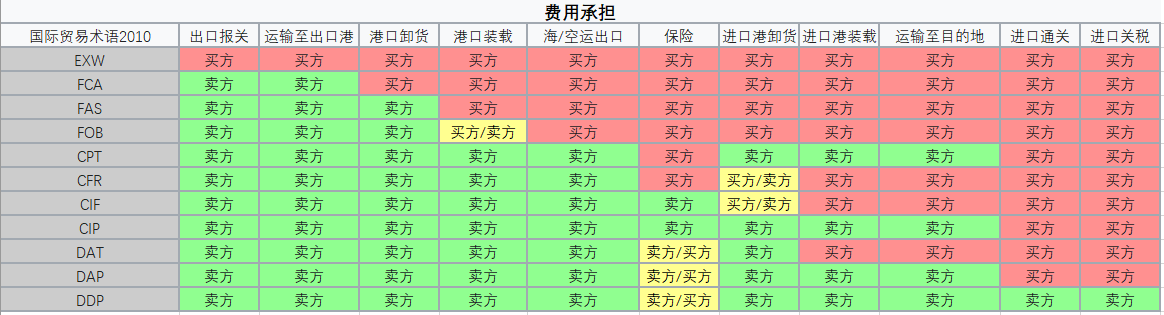
In simple terms,trade terms can be seen as the language of international trade.They clearly define the delivery location of goods,who pays for freight and insurance,and when the risk transfers from the seller to the buyer.Through these abbreviated letters,trading parties worldwide can understand the composition of the goods price,as well as the respective costs,risks,and responsibilities each party bears,without needing to describe every detail in the contract.
List of Parties Responsible for Costs between Buyers and Sellers under Various Trade Terms
How to calculate FOB price?
In theIn daily work,the most critical aspect is calculating the FOB price.Even if the transaction method on your declaration form is not FOB,you need to know how to convert it to FOB price.The specific conversion method is as follows:
FOB=CIF?Freight?Insurance
Here,"C" stands for COST,"I" stands for INSURANCE,and "F" stands for FREIGHT.
Whether you are a beginner or a seasoned professional,a deep understanding and mastery of customs declaration forms,transaction methods,and trade terms in export business are essential.This ensures that everything proceeds correctly,whether when signing contracts with clients or handling actual customs procedures,avoiding unnecessary complications and losses.
As a one-stop importservice provider,we can offer customizedsolutions for various industries.If you requireimport-export agency services,please contact us for business consultation.Hotline: 139-1787-2118.
Was this helpful? Give us a like!
Contact our experts for compliance audits, precise quotes, and one-stop customs support.
Recent Comments (0) 0
Leave a Reply