
House Bill of Lading (HBL): Operations, Uses & FAQs Guide
or complex compliance issues.
clearance and fund security.
Master the House Bill of Lading (HBL).Learn its operations,vital uses in freight forwarding,and answers to common questions.Essential guide for optimizing your shipping documentation and logistics.
I.Operational process and importance of the Non - Vessel Operating Common Carrier (NVOCC) bill of lading
The NVOCC bill of lading is an indispensable legal document in cargo transportation,ensuring the smooth progress of all links from loading to delivery.This document is usually issued by a freight forwarder and contains details of the ownership of the goods and relevant information.If this document is missing or contains errors,you may face various legal and logistics issues.
Take a specific example.Suppose acompany needs to ship leather products from China to Japan.In this process,the NVOCC bill of lading plays several key roles:
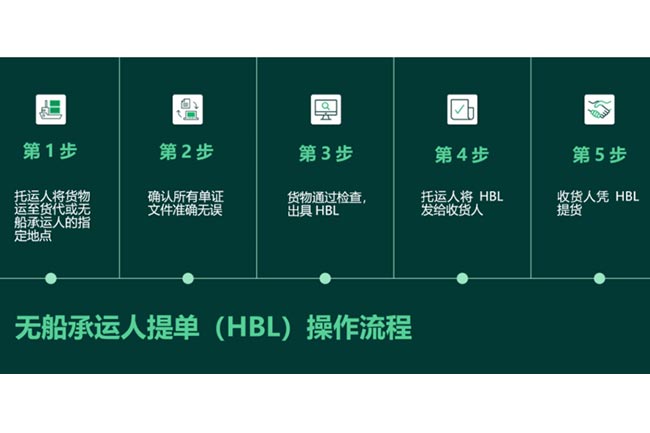
1) Step 1: You need to transport the goods to the location designated by the freight forwarder or NVOCC (Non - Vessel Operating Common Carrier).
2) Step 2: Ensure that all transportation documents are complete and correct.
3) Step 3: The freight forwarder will inspect your goods and then issue the NVOCC bill of lading.
4) Step 4: You send this bill of lading to the consignee in Japan.
5) Step 5: The consignee will pick up the goods at the destination port based on this bill of lading.
This operational process not only ensures the smooth transportation of goods from the source to the destination but also provides legal protection for all parties.
II.Comparison between the NVOCC bill of lading and the master bill of lading
The NVOCC bill of lading (HBL) and the master bill of lading (MBL) are two common but functionally different bills of lading.
1) NVOCC bill of lading (HBL): Usually issued by a freight forwarder or NVOCC,representing the transportation contract between the shipper and the consignee.This bill of lading is usually negotiable.
2) Master bill of lading (MBL): Usually issued by the carrier or shipowner,representing the transportation contract between the shipper and the carrier.This bill of lading is usually non - negotiable.
The main difference between the two lies in their issuers and scope of action.The master bill of lading usually covers the entire consolidated shipment,while the NVOCC bill of lading is for the specific goods of an individual shipper.
III.Format and content of the NVOCC bill of lading
Although different container companies may have different bill - of - lading formats,a standard NVOCC bill of lading usually includes the following main parts:
1) Detailed information of the shipper and the consignee
2) Detailed description of the goods,such as quantity,weight,size,etc.
3) Voyage and port information,such as the name of the ship,voyage number,port of departure,port of destination,etc.
4) Freight and other possible additional charges
5) Contract terms and conditions,such as liability and insurance,etc.
This information not only provides clear rights and obligations for all parties but also is crucial for the customs clearance and delivery of goods.

IV.Common questions and answers
In actual operation,the NVOCC bill of lading may bring a series of problems,especially if this bill of lading contains errors or is lost.
Q: What are the consequences if there are errors in the NVOCC bill of lading?
A: Incorrect information in the bill of lading may lead to problems in customs,delivery,etc.such as delays,additional costs,or legal disputes.Once an error is found,it should be corrected immediately.
Q: Can the NVOCC bill of lading be transferred or changed?
A: Generally,the NVOCC bill of lading is negotiable,which means its ownership can be transferred through endorsement,etc.But this also depends on the terms clearly specified in the bill of lading.
Q: What should be done if the bill of lading is lost?
A: The loss of a bill of lading is a very serious issue because it is a legal document of goods ownership.In this case,it is usually necessary to apply to the freight forwarder or NVOCC that issued the bill of lading for a re - issue,and it may be necessary to provide guarantees or other certificates to avoid possible legal disputes.
Q: B/LWhen clearing customs,in addition to the regular documents,we will pay special attention to the”: In the Freight column of the customs declaration form,fill in the actual freight amount incurred.Purchase credit insurance方”Is.What意思?
A: “: In the Freight column of the customs declaration form,fill in the actual freight amount incurred.Purchase credit insurance方”Is.指負(fù)責(zé)Purchase credit insuranceand transportationThere are關(guān): A single operation costs about(such as: In the Freight column of the customs declaration form,fill in the actual freight amount incurred.SurchargeDamage during transportationWe have obtained the business filing certificate.We are well aware that when importing medical devices,it is necessary to ensure that the products have the corresponding Chinese medical device registration certificates.Even if an enterprise has the business filing,if the product does not have the corresponding registration certificate,it still cannot be legally imported.In addition,the model and specifications of the imported product must be completely consistent with the information on the registration certificate.Any discrepancies may lead to import obstruction.We will ensure that your products meet all registration requirements and smoothly enter the Chinese market.一方.According toContract Terms,這Yes.Is.托運(yùn)人,Receive貨人orThird party.
Overall,the NVOCC bill of lading is an extremely important part of cargo transportation.Understanding its operation process,functions,and differences from the master bill of lading can help enterprises and individuals manage cargo transportation more effectively,reduce risks,and improve efficiency.
Was this helpful? Give us a like!
Contact our experts for compliance audits, precise quotes, and one-stop customs support.
Recent Comments (0) 0
Leave a Reply