
US Critical Minerals: Decoupling from China Risks
or complex compliance issues.
clearance and fund security.
The article titled "Breaking Away from China in ’Critical Minerals’: The U.S.Accelerates Domestic Production," published by Japan’s Asahi Shimbun on July 21,analyzes the challenges the United States faces in its attempt to reduce dependence on China in the field of critical minerals.With the increasing demand for high-tech products such as electric vehicles and fighter jets,the U.S.has begun to accelerate domestic production of critical minerals and impose additional tariffs on Chinese products.However,this strategy may carry the risk of economic instability.
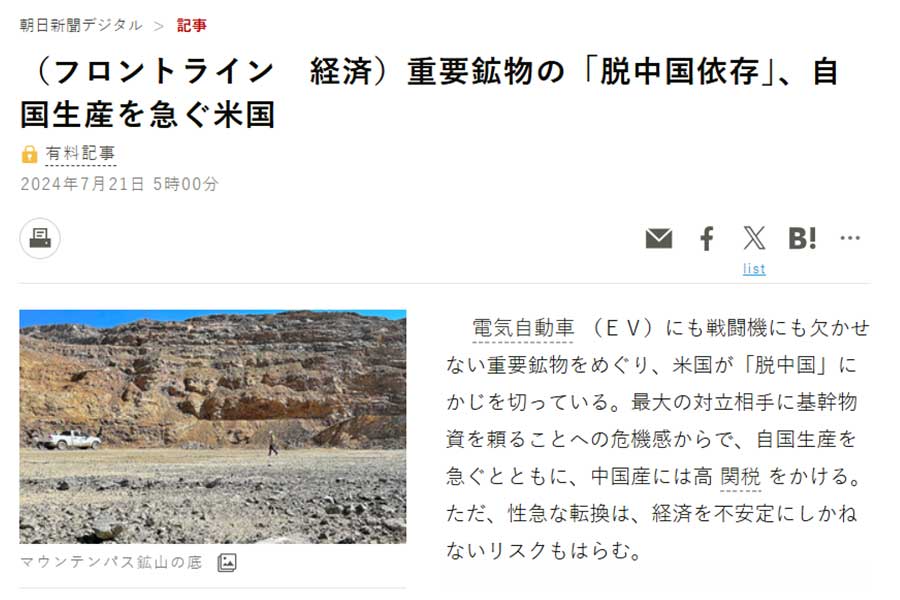
The U.S.Dependence on China for Critical Minerals
In the southern California desert,Mountain Pass is the only rare earth mine in the U.S.Mountain Pass Materials is dedicated to developing neodymium,a rare earth element critical for manufacturing electric vehicles and wind power equipment.Although the U.S.government will provide over $100 million in subsidies to Mountain Pass Materials,current U.S.lithium production meets only 4% of electric vehicle demand,cobalt production 13%,and nickel and graphite production 0%.In contrast,China processes over 80% of the worlds critical minerals.
U.S.National Security Advisor Jake Sullivan stated that America’s reliance on China in the field of critical minerals is a "threat to national security." In response,the U.S.government has imposed high tariffs on Chinese-made electric vehicle batteries and their key minerals while accelerating domestic production efforts.
Economic Challenges of Tariffs and Domestic Production
The Biden administrations Inflation Reduction Act,passed in 2022,aims to promote the adoption of electric vehicles in North America,offering up to $7,500 in tax credits per vehicle assembled in North America.However,the act stipulates that these vehicles must use critical minerals mined and processed in countries with free trade agreements with the U.S.or they will not qualify for tax credits.
Although this policy aims to achieve the goals of "reducing dependence on China" and "decarbonization," its economic costs are high.The high costs of domestic production in the U.S.may lead to price increases and fiscal deterioration,thereby undermining economic stability.Abandoning this option could achieve decarbonization and economic stability,but for the U.S.and its allies,who view China as an "adversarial nation," this is not a desirable choice.
The "trilemma" we are facing
The United States faces a trilemma in advancing its "decoupling from China" strategy:
Balancing reduced dependence on China with economic stability Output:
Choosing complete decoupling from China means the U.S.must pursue high-cost domestic production,which could lead to economic instability.High production costs and supply chain adjustments would place significant pressure on the U.S.economy,potentially triggering inflation and rising fiscal deficits.
2.Delays in decarbonization progress Output:
If the U.S.chooses to reduce dependence on China while maintaining economic stability,decarbonization progress will inevitably be affected.Chinas low-cost minerals and components largely support global decarbonization efforts.Without reliance on Chinese minerals,the costs of electric vehicles and renewable energy equipment would rise sharply,hindering decarbonization goals.
3.Dual pressures from international politics and economics Output:
On the international political front,the U.S.and its allies cannot ignore U.S.intentions.Continuing to rely on China may be seen as weakness and irresponsibility.Economically,however,reducing dependence on China presents significant challenges.Finding a balance between these two is a major dilemma for the U.S.
Was this helpful? Give us a like!
Contact our experts for compliance audits, precise quotes, and one-stop customs support.
Recent Comments (0) 0
Leave a Reply